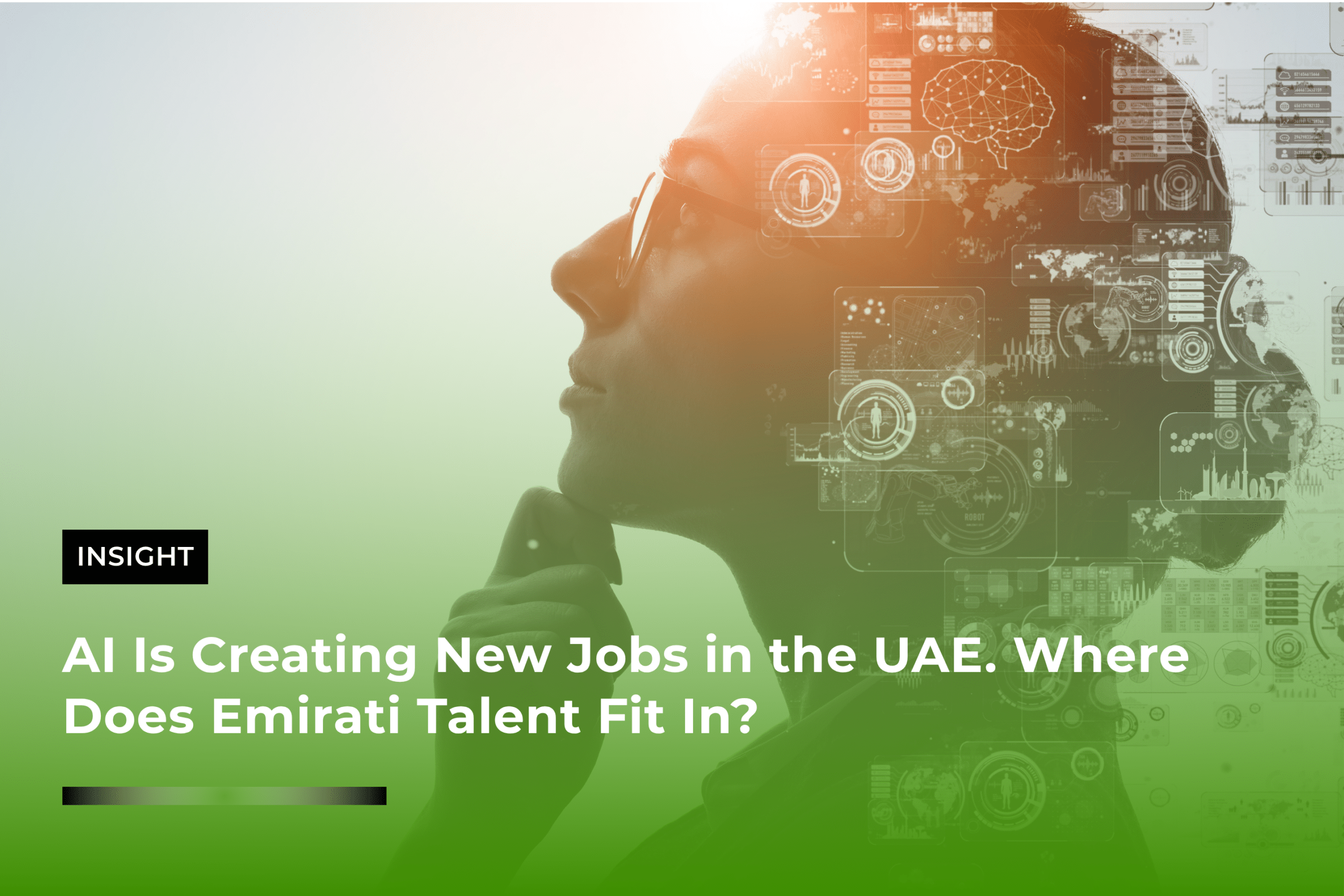
Artificial intelligence is changing the UAE employment market.
Businesses are introducing AI into customer service, finance, healthcare, marketing, logistics, cybersecurity, government services, and everyday business operations. At the same time, new positions are emerging around data, automation, AI governance, machine learning, and digital transformation.
This creates an important question for employers:
Where does Emirati talent fit into the UAE’s AI-driven workforce?
The answer extends far beyond hiring UAE nationals as software engineers.
As AI becomes part of almost every business function, Emirati professionals have opportunities to participate as developers, analysts, project managers, cybersecurity specialists, compliance professionals, product managers, strategists, and future technology leaders.
For employers, this also creates an opportunity to connect Emiratisation with another long-term priority: building the skills their businesses will need in an AI-driven economy.
How AI Is Changing Jobs in the UAE
AI does not affect every position in the same way.
Some jobs are becoming more automated. Others are being redesigned around AI tools, while entirely new roles are emerging.
Businesses are increasingly using AI for tasks such as:
- Data analysis.
- Customer support.
- Fraud detection.
- Document processing.
- Marketing automation.
- Recruitment support.
- Financial forecasting.
- Cybersecurity monitoring.
- Supply chain optimisation.
- Business intelligence.
As adoption increases, employees increasingly need to understand how to work with AI, even when they do not work in a technology department.
AI Jobs Are Not Just for Programmers
One common misconception is that an AI career requires advanced programming skills.
Technical expertise is essential for certain positions, but the wider AI economy requires many different professionals.
Technical AI Roles
These may include:
- AI engineers.
- Machine learning engineers.
- Data scientists.
- Software developers.
- Data engineers.
- Cloud engineers.
- Cybersecurity specialists.
These positions generally require stronger technical qualifications and experience.
AI-Enabled Business Roles
AI is also changing positions in:
- Finance.
- Human resources.
- Marketing.
- Operations.
- Sales.
- Customer experience.
- Procurement.
- Project management.
Employees in these functions may not build AI systems themselves, but they increasingly need to understand how to use AI tools effectively and responsibly.
AI Governance and Risk Roles
As organisations deploy AI, they also need professionals who can help manage issues involving:
- Governance.
- Risk.
- Compliance.
- Data privacy.
- Cybersecurity.
- Responsible AI use.
- Internal policies.
These areas can create opportunities for professionals with legal, regulatory, risk, technology, and business backgrounds.
Where Emirati Talent Fits Into the AI Economy
Artificial Intelligence and Machine Learning
Emirati graduates and experienced technology professionals can build careers directly within AI development.
Potential pathways include:
- Machine learning.
- Natural language processing.
- Computer vision.
- Generative AI.
- AI engineering.
- Applied AI research.
These are highly specialised careers that require strong technical foundations and continuous learning.
Data and Analytics
AI systems depend heavily on data.
This creates opportunities for Emirati professionals in:
- Data analysis.
- Data engineering.
- Business intelligence.
- Data science.
- Data governance.
- Analytics.
For many graduates, data analytics can also provide an accessible pathway into the wider AI sector.
Cybersecurity
As organisations become more digital, cybersecurity remains critical.
AI can strengthen security capabilities, but it can also introduce new risks.
Emirati professionals can build careers in:
- Security operations.
- Threat analysis.
- Cloud security.
- Identity management.
- Cyber risk.
- Security governance.
- AI-related security.
AI Governance and Compliance
Businesses adopting AI need people who understand both technology and organisational risk.
This creates potential opportunities for Emiratis with backgrounds in:
- Law.
- Compliance.
- Risk management.
- Data governance.
- Information security.
- Public policy.
- Corporate governance.
The ability to translate technical risks into business decisions can become particularly valuable.
AI Is Also Transforming Traditional Careers
Not every Emirati professional needs to move into a dedicated technology role.
For many employees, the bigger opportunity is learning how AI changes their existing profession.
Human Resources
HR professionals can use AI-supported tools for areas such as:
- Recruitment workflows.
- Workforce analytics.
- Learning and development.
- Employee support.
- Administrative automation.
The valuable skill is not simply knowing how to use an AI tool. It is understanding when to use it, how to assess its output, and when human judgement remains necessary.
Finance
Finance professionals increasingly encounter AI in:
- Forecasting.
- Fraud detection.
- Reporting.
- Risk analysis.
- Process automation.
Combining financial expertise with digital capability can create stronger career opportunities.
Marketing
AI is transforming:
- Research.
- Content workflows.
- Customer segmentation.
- Advertising.
- Analytics.
- Personalisation.
Marketing professionals who understand both customer behaviour and AI-assisted tools can become increasingly valuable.
Operations
AI can help businesses improve:
- Scheduling.
- Inventory.
- Logistics.
- Procurement.
- Forecasting.
- Process optimisation.
Operations professionals who can identify practical automation opportunities may become important contributors to digital transformation.
Skills Emirati Professionals Need for an AI-Driven Workplace
AI Literacy
Employees should understand basic concepts such as:
- What AI can and cannot do.
- How generative AI works at a practical level.
- How to evaluate AI-generated information.
- Appropriate business uses.
- Risks and limitations.
AI literacy is likely to become increasingly relevant even outside technology departments.
Data Literacy
Professionals should be comfortable interpreting information and making evidence-based decisions.
Useful capabilities include:
- Excel.
- Data visualisation.
- Dashboards.
- Basic analytics.
- Understanding key performance indicators.
More technical careers may require SQL, Python, statistics, or specialised analytics platforms.
Critical Thinking
AI can generate answers quickly.
That makes the ability to evaluate those answers even more important.
Employees need to ask:
- Is this information accurate?
- Is important context missing?
- Is the output appropriate for this situation?
- Does a human need to verify the decision?
Human judgement remains critical.
Communication
Technical knowledge creates more value when employees can explain it clearly.
Professionals who can communicate between technical teams, management, customers, and regulators can play important roles in AI transformation.
Adaptability
The tools businesses use today may look very different within a few years.
Employees therefore need the ability to learn continuously rather than relying on one technology throughout their careers.
What Fresh Emirati Graduates Should Focus On
Fresh graduates do not necessarily need to become AI experts immediately.
A strong foundation might include:
- Digital literacy.
- AI fundamentals.
- Excel and data analysis.
- Professional communication.
- Problem-solving.
- Presentation skills.
- Industry knowledge.
- Practical project experience.
Graduates interested in technical careers can then develop more specialised capabilities in programming, machine learning, cloud technologies, cybersecurity, or data science.
Employers Should Not Wait for Perfect AI Candidates
One challenge businesses may face is searching for candidates who already have several years of experience in technologies that are themselves relatively new.
That can unnecessarily narrow the talent pool.
Employers should distinguish between:
Skills that must exist on day one
and
Skills that can be developed after hiring.
A high-potential Emirati graduate with strong analytical ability, technical foundations, curiosity, and communication skills may become extremely valuable with the right training.
How Employers Can Develop Emirati AI Talent
Create AI Graduate Programmes
Graduate programmes can combine:
- Technical training.
- Business exposure.
- AI projects.
- Mentorship.
- Department rotations.
This helps employees understand both technology and its commercial applications.
Provide Professional Training
Existing Emirati employees can also be upskilled.
Training might cover:
- AI fundamentals.
- Data analytics.
- Automation.
- Cybersecurity.
- Cloud platforms.
- AI governance.
- Responsible AI practices.
Give Employees Real Projects
Training alone is not enough.
Employees should have opportunities to apply new skills to actual business problems.
For example:
- Automating a manual process.
- Analysing customer data.
- Improving reporting.
- Testing an AI-supported workflow.
- Supporting an internal digital transformation project.
Practical experience accelerates development.
Build Mentorship Into the Programme
Experienced technical and business leaders can help employees understand how AI connects with real organisational challenges.
Mentorship can also support long-term career progression.
Don’t Make AI Development a Separate Emiratisation Exercise
There is a risk that businesses treat AI and Emiratisation as two unrelated strategies.
One team focuses on digital transformation.
Another focuses on Emiratisation targets.
A stronger approach connects them.
If your organisation knows it will need more capabilities in data, cybersecurity, automation, AI governance, or digital operations over the next three years, those requirements can become part of Emirati workforce planning today.
Build Emirati Talent for the Jobs You Will Need Tomorrow
Instead of asking only:
“Which Emirati vacancies do we need to fill now?”
employers should ask:
- Which jobs will AI change in our organisation?
- Which new skills will we need?
- Which employees can be upskilled?
- Which graduates could be developed?
- Where will we need future specialists?
- Who could eventually lead our digital transformation?
This turns Emiratisation into strategic workforce development.
AI Can Create Leadership Opportunities Too
The long-term opportunity is not only technical employment.
As UAE organisations become more AI-driven, they will need leaders who understand:
- Technology.
- Business strategy.
- Risk.
- People.
- Regulation.
- Customers.
Developing Emirati professionals across these areas can create future:
- Heads of Digital Transformation.
- AI programme leaders.
- Data leaders.
- Cybersecurity leaders.
- Technology executives.
- Innovation managers.
- Governance and risk leaders.
Employers should therefore think beyond entry-level hiring.
The Human Skills AI Makes More Valuable
Ironically, greater AI adoption can make certain human capabilities even more important.
These include:
- Leadership.
- Creativity.
- Critical thinking.
- Negotiation.
- Emotional intelligence.
- Communication.
- Ethical judgement.
- Relationship management.
AI can support decisions, but organisations still need people who understand customers, manage teams, evaluate risks, and take responsibility for outcomes.
What This Means for Emiratisation Recruitment
Employers recruiting UAE nationals should increasingly consider both current job requirements and future skills.
Job descriptions may need to evolve.
Candidate assessments may need to look beyond years of experience.
Training budgets may need to increase.
Graduate programmes may need stronger digital components.
And recruitment teams may need to build Emirati talent pipelines for positions that barely existed a few years ago.
Conclusion
AI is creating new opportunities across the UAE, but Emirati participation in that future will not be limited to software engineers and data scientists.
UAE nationals can contribute across AI development, cybersecurity, analytics, governance, finance, HR, marketing, operations, project management, and leadership.
For Emirati professionals, the opportunity is to combine industry expertise with digital capability and continuous learning.
For employers, the opportunity is even bigger: instead of waiting for a fully developed AI talent market, businesses can identify promising UAE nationals today and develop the specialists and leaders they will need tomorrow.
The question is no longer simply:
“Where does Emirati talent fit into AI?”
It is:
“How do we make sure Emirati talent helps lead the UAE’s AI-driven economy?”
Frequently Asked Questions
What AI jobs are available for Emirati professionals in the UAE?
Potential career paths include AI engineering, machine learning, data science, cybersecurity, data analytics, cloud technology, AI governance, digital transformation, product management, and technology project management.
Do Emirati professionals need programming skills to work with AI?
Not always. Technical AI roles may require programming, but many business, governance, operations, HR, finance, marketing, and management roles increasingly require AI literacy rather than advanced software development.
What AI skills should fresh Emirati graduates learn?
Graduates can start with AI fundamentals, digital literacy, data analysis, critical thinking, communication, and practical AI tools. Those pursuing technical careers can add programming, machine learning, cloud, cybersecurity, and advanced analytics.
How can UAE employers develop Emirati AI talent?
Employers can provide graduate programmes, technical training, mentorship, professional certifications, real AI projects, cross-functional experience, and structured career progression.
Can existing Emirati employees be trained for AI-related roles?
Yes. Upskilling existing employees can be an effective way to build AI capability, particularly when employees already understand the organisation, customers, industry, and business processes.
Why should AI skills be included in Emiratisation workforce planning?
AI is changing both technical and non-technical jobs. Connecting digital skills development with Emiratisation can help businesses prepare UAE national employees for future roles while building the capabilities the organisation will need as technology evolves.