
Your company has an open position, but finding the right Emirati candidate is taking longer than expected.
You have advertised the vacancy, reviewed applications and conducted interviews. Yet some qualified candidates are looking for something your company does not currently offer: flexibility.
One candidate prefers reduced working hours. Another is interested in a hybrid arrangement. A third has the skills you need but cannot commute to your office every day.
Does that mean these candidates are unsuitable for your business?
Not necessarily.
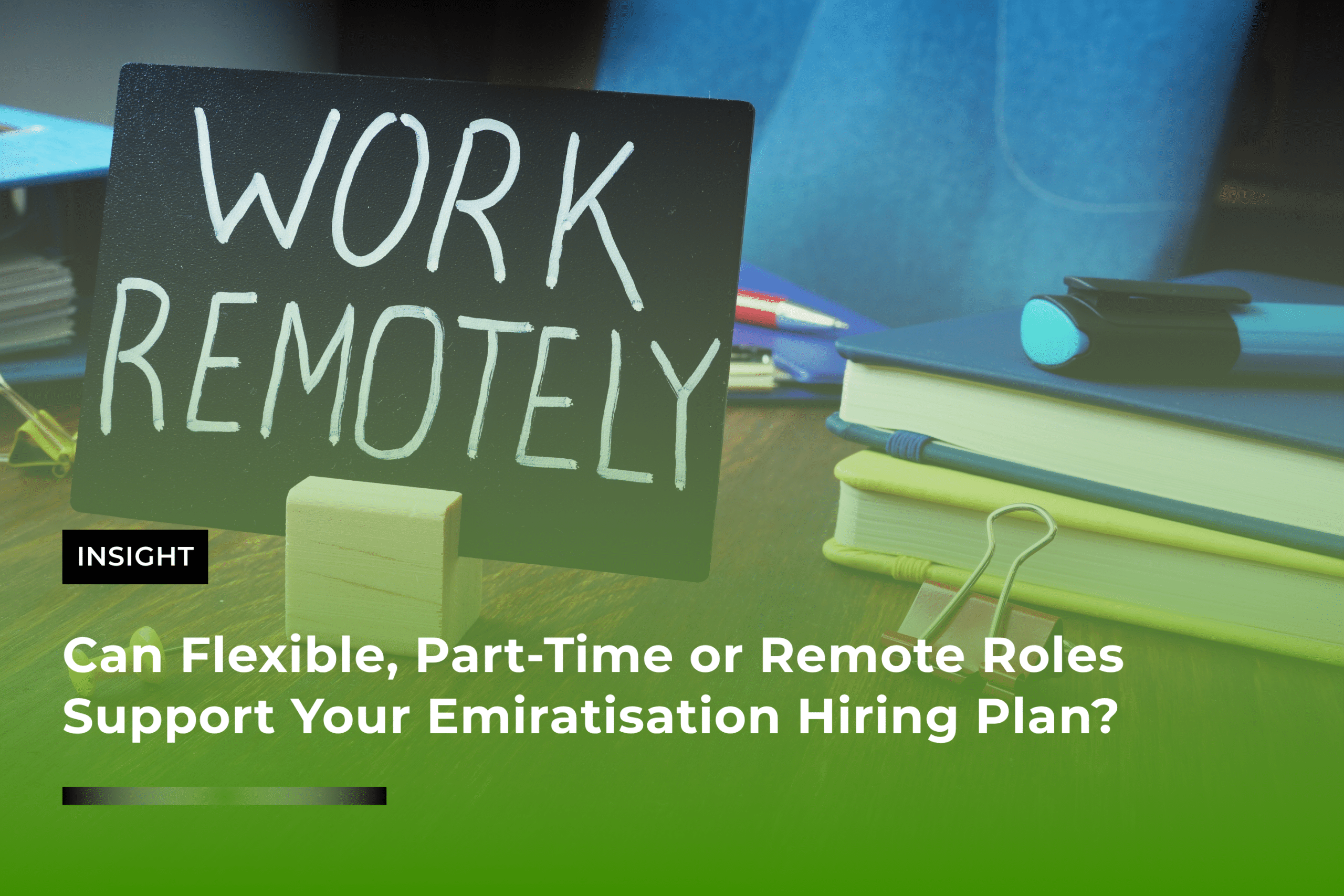
Flexible, part-time and remote working arrangements can help UAE employers reach a wider pool of Emirati professionals. They may also create opportunities to recruit candidates who would not otherwise consider a conventional full-time, office-based position.
However, there is an important distinction.
A working arrangement may be legally available without automatically satisfying every requirement for Emiratisation recognition.
Employers need to consider both the operational suitability of the role and the applicable employment and regulatory requirements.
Why Traditional Hiring Models Can Limit Your Emirati Talent Pool
Many businesses still approach Emiratisation recruitment with a standard employment model.
The position is full-time, office-based and requires employees to follow fixed working hours.
That structure may be appropriate for some roles, but it is not necessarily essential for every position.
Consider jobs involving:
- Digital marketing.
- Data analysis.
- Human resources.
- Finance and reporting.
- Project coordination.
- Software development.
- Customer support.
- Business consulting.
- Research.
- Administrative services.
Depending on the responsibilities, some of these positions may be performed through alternative working arrangements.
If employers insist on conventional office attendance for every vacancy, they may unnecessarily exclude qualified candidates.
What Flexible Employment Means in the UAE
The UAE’s private-sector employment framework recognises different working models.
These include full-time, part-time, temporary, flexible, remote and job-sharing arrangements, subject to the relevant rules and circumstances.
Each model serves a different purpose.
Part-Time Employment
Part-time employment generally involves working fewer hours or days than a comparable full-time arrangement.
It may suit a business that needs specialist expertise without requiring a full-time position.
For example, a company may need an experienced Emirati professional to support a particular business function for a limited number of working days each week.
Remote Employment
Remote work allows employees to perform their responsibilities away from the employer’s usual workplace, subject to the agreed arrangements and applicable requirements.
It can be suitable for positions where tasks can be completed securely and effectively without daily physical attendance.
Flexible Working Hours
Flexible arrangements can provide employees with greater control over when they perform their duties, within the requirements of the role and the agreed employment conditions.
For example, an employer may allow different starting and finishing times while maintaining core working hours.
Hybrid Working
Hybrid arrangements combine office-based and remote work.
This model can help businesses retain in-person collaboration while providing greater flexibility.
The specific legal and contractual treatment should be determined according to the actual employment arrangement.
Can Flexible Roles Count Towards Emiratisation?
This is one of the most important questions employers should address before introducing alternative working models.
MoHRE’s published guidance recognises employment arrangements beyond conventional full-time work. However, employers should verify how a particular employee and working arrangement will be treated under the Emiratisation requirements applicable to their establishment.
Relevant considerations include:
- The appropriate work permit.
- The employment contract.
- Applicable pension and social-security registration.
- Wage-payment compliance.
- The employee’s actual duties.
- The relevant establishment records.
- The company’s applicable Emiratisation calculation.
Employers should not assume that offering a remote or part-time contract automatically establishes Emiratisation compliance.
The safest approach is to verify the specific arrangement through official MoHRE channels before relying on it to meet a target.
How Flexible Working Can Improve Emirati Recruitment
1. Access to a Wider Candidate Pool
A conventional office-based position may attract candidates living within a reasonable commuting distance.
Remote or hybrid arrangements can potentially extend recruitment beyond that immediate area.
For example, a Dubai-based employer may be able to consider qualified UAE nationals living in another emirate for a role that can genuinely be performed remotely.
This can be particularly valuable when recruiting for specialised positions.
2. Greater Appeal to Experienced Professionals
Experienced candidates often consider more than salary when evaluating an opportunity.
They may also assess:
- Working arrangements.
- Career progression.
- Professional responsibilities.
- Management quality.
- Development opportunities.
- Work-life balance.
Offering appropriate flexibility can strengthen an employer’s overall recruitment proposition.
3. Opportunities for Candidates Returning to Work
Some professionals may prefer a gradual return to employment after a career break.
Part-time or flexible positions can provide an opportunity to rebuild professional experience while contributing meaningful skills to the organisation.
Employers may benefit from access to experienced candidates who would not initially consider a conventional full-time role.
4. Better Access to Specialist Skills
A business may need expertise in a particular function but lack sufficient work to justify a full-time position.
Where the employment arrangement is appropriate and compliant, part-time recruitment may allow the company to engage a qualified Emirati professional for genuine business needs.
5. Potential Improvements in Retention
Flexibility can also support employee retention when it aligns with the role and individual circumstances.
Employees who can manage their responsibilities effectively may be more likely to view the organisation as a sustainable long-term employer.
However, flexibility alone does not guarantee retention.
Career development, management support, compensation and meaningful responsibilities remain important.
Which Roles May Be Suitable for Flexible or Remote Emirati Recruitment?
Not every position can be performed remotely or part-time.
Employers should assess the practical requirements of each vacancy.
Technology and Data
Certain technology positions may be suitable for remote or hybrid arrangements.
Examples include:
- Software development.
- Data analysis.
- Business intelligence.
- Cybersecurity analysis.
- IT project coordination.
Some roles may still require physical attendance for security, infrastructure or operational reasons.
Marketing and Communications
Depending on the organisation, flexible arrangements may be suitable for:
- Digital marketing.
- Content development.
- Social media management.
- Market research.
- Marketing analytics.
- Corporate communications.
Human Resources
Some HR functions may support hybrid arrangements, including:
- Recruitment coordination.
- Candidate sourcing.
- HR reporting.
- Learning and development.
- HR analytics.
Other responsibilities, such as certain employee relations or operational activities, may require on-site presence.
Finance and Administration
Selected reporting, analysis and administrative functions may also be suitable for flexible working.
However, employers must consider confidentiality, information security and internal controls.
Consulting and Project Management
Some consulting and project-based roles can offer flexibility depending on client requirements, project timelines and operational needs.
The decision should be based on the actual responsibilities rather than the job title alone.
Don’t Create a Flexible Role That Exists Only on Paper
Flexible working should never become a shortcut for creating artificial employment arrangements.
A legitimate remote or part-time Emirati employee should have genuine work to perform.
Employers should establish:
- A clear job description.
- Agreed responsibilities.
- Appropriate supervision.
- Defined performance expectations.
- Accurate employment records.
- Proper remuneration.
- Relevant reporting arrangements.
An employee working remotely should still be integrated into the organisation.
Likewise, a part-time employee should have responsibilities that correspond to the agreed employment arrangement.
Artificial employment structures designed to create the appearance of Emiratisation compliance can raise serious regulatory concerns.
How to Design a Genuine Flexible Emirati Position
Step 1: Identify the Business Requirement
Start with the work that needs to be completed.
Ask:
- What responsibilities does this position involve?
- How many working hours are genuinely required?
- Does the employee need to attend the office?
- Can performance be measured through deliverables?
- What level of supervision is necessary?
The employment model should follow the business requirement.
Step 2: Select the Appropriate Working Arrangement
Determine whether the role is best suited to:
- Full-time employment.
- Part-time employment.
- Flexible hours.
- Remote working.
- A hybrid arrangement.
The chosen structure should reflect the actual duties and comply with the applicable employment requirements.
Step 3: Verify the Regulatory Position
Before issuing an offer, confirm the appropriate work-permit and contractual requirements.
If the company intends to rely on the employee for Emiratisation compliance, verify how the arrangement will be treated.
Step 4: Create a Clear Job Description
A flexible position still requires clearly defined responsibilities.
The job description should explain:
- Core duties.
- Expected outcomes.
- Reporting relationships.
- Required skills.
- Working arrangements.
- Performance expectations.
Step 5: Establish Communication and Supervision
Remote and flexible employees should have regular contact with their managers.
This may include scheduled meetings, progress reviews and collaborative work.
The objective is to ensure the employee receives the same professional support as other team members.
Step 6: Monitor Performance and Development
Flexible employees should not be excluded from career development.
Provide opportunities for:
- Training.
- Mentorship.
- Professional certifications.
- Project ownership.
- Internal progression.
- Performance reviews.
Flexibility should describe how the employee works, not limit their professional future.
What Employers Should Consider Before Offering Remote Work
Remote employment can create additional operational considerations.
Data Security
Employees may access sensitive business information outside the office.
Employers should establish appropriate security controls, access permissions and confidentiality procedures.
Communication
Managers need clear expectations for meetings, availability and reporting.
Performance Measurement
Performance should be assessed through relevant responsibilities and outcomes rather than assumptions about physical presence.
Equipment and Technology
The company should determine what equipment, systems and technical support the employee needs.
Employee Engagement
Remote employees should remain connected to their colleagues and the wider organisation.
Without appropriate management, remote work can create isolation or limit professional visibility.
Part-Time Employment Should Not Mean Limited Career Opportunities
One concern with part-time positions is that employees may be treated as temporary additions rather than valued members of the workforce.
Employers should avoid this approach.
Where appropriate, part-time Emirati professionals should have access to:
- Relevant training.
- Regular feedback.
- Meaningful assignments.
- Professional development.
- Internal opportunities.
- Recognition for their contributions.
A part-time arrangement can still support a long-term career.
How Flexible Working Can Support Emiratisation Retention
Recruitment is only one part of workforce planning.
Employers must also consider what happens after a UAE national joins the organisation.
For example, an employee may perform well but later need greater flexibility.
If the business can accommodate an appropriate change in working arrangements, it may be able to retain an experienced professional rather than beginning another recruitment process.
Potential retention measures include:
- Flexible starting and finishing times.
- Hybrid attendance where suitable.
- Adjusted working arrangements.
- Structured return-to-work plans.
- Regular discussions about employee needs.
Any contractual changes should be documented and implemented in accordance with applicable requirements.
What Smaller UAE Employers Can Learn From Flexible Recruitment
Large employers may have established brands and extensive recruitment resources.
Smaller businesses can sometimes compete by offering a more personalised employment experience.
For example, a growing company may provide:
- Direct access to management.
- Greater project ownership.
- Flexible working arrangements.
- Faster decision-making.
- Broader responsibilities.
- Individual career development.
These advantages can help attract candidates whose priorities extend beyond company size.
However, employers should communicate only the flexibility they can genuinely provide.
Common Mistakes Employers Should Avoid
Offering Flexibility Without Defining Expectations
Employees and managers need a shared understanding of working hours, responsibilities and deliverables.
Assuming Every Flexible Hire Counts Automatically
The employer should verify the applicable Emiratisation requirements rather than relying on the employment model alone.
Ignoring Pension and Payroll Requirements
Alternative working arrangements do not remove applicable statutory obligations.
Treating Remote Employees Differently
Remote employees should receive appropriate management support, feedback and development opportunities.
Hiring Solely to Satisfy a Headcount Requirement
Every employment arrangement should involve genuine work and comply with the relevant rules.
Should Flexible Working Be Part of Your Emiratisation Strategy?
For many businesses, it is worth considering.
The decision should depend on three questions:
1. Does the role genuinely support flexible, part-time or remote work?
2. Can the business manage the arrangement effectively?
3. Does the employment structure meet the applicable regulatory requirements?
If the answer to all three is yes, alternative working arrangements may provide another way to attract and retain qualified Emirati professionals.
Conclusion
Flexible, part-time and remote working arrangements can help UAE employers broaden their Emirati recruitment strategies.
They may provide access to experienced professionals, candidates living in different emirates, individuals returning to employment and specialists seeking alternative working patterns.
However, flexibility should not be treated as an automatic route to Emiratisation compliance.
Employers must ensure that the position is genuine, the appropriate employment processes are followed, and the employee’s treatment under the applicable Emiratisation requirements is verified.
The objective is not simply to make hiring easier.
It is to create employment opportunities that work for both the business and the UAE national.
Sometimes, attracting the right Emirati candidate does not require changing who you hire. It requires reconsidering how the role can be performed.
Frequently Asked Questions
Can Emirati employees work remotely in the UAE?
Yes. Remote working is a recognised employment arrangement under the UAE’s private-sector framework, subject to applicable requirements and the nature of the position.
Can part-time Emirati employees support an employer’s Emiratisation target?
Potentially, subject to the applicable rules and employment conditions. Employers should verify the specific arrangement and its recognition through official MoHRE channels.
Does a remote Emirati employee need a work permit?
Where the employment falls under MoHRE’s jurisdiction, the appropriate work-permit and employment-contract requirements apply.
Can a Dubai company hire an Emirati employee living in another emirate?
A company may consider candidates residing in another emirate, provided the employment arrangement is lawful and the role can be performed as agreed. Employers should confirm any applicable administrative requirements.
Which jobs are suitable for flexible Emirati recruitment?
Depending on their responsibilities, positions in technology, data analysis, marketing, HR, finance, administration, consulting and project management may support flexible arrangements.
Can flexible working help employers retain Emirati talent?
It can. Appropriate flexibility may improve the employee experience and help employers retain skilled professionals. However, career development, compensation, management support and meaningful work remain important.
How can employers ensure flexible Emirati employment is genuine?
Businesses should maintain accurate contracts, assign meaningful responsibilities, establish appropriate supervision, comply with payroll and pension requirements, and document the actual employment arrangement.